
IC Supplier Risk Matrix Analysis: Graded Supply Risk & Inventory Strategy for Mainstream Chip Vendors
Target Audience: Hardware R&D Engineers, Supply Chain Buyers, BOM Engineers, Industrial Control & Consumer Electronics Project Managers
Core Value: Based on the IC supplier risk assessment matrix, this article quantifies three core risks of mainstream semiconductor manufacturers — price hike, delivery delay, and supply instability. It provides practical inventory, replacement and risk control strategies to avoid project shutdowns and order delays.
The global semiconductor market continues to face imbalanced supply and demand. Coupled with geopolitical supply chain fluctuations, tight capacity allocation by original manufacturers, and recovering market demand, IC shortages, price increases and extended lead times have become normalized.
For enterprises engaged in hardware R&D, industrial control equipment, power products and consumer electronics, material risks are no longer merely cost issues. They have become core bottlenecks restricting project progress, mass production delivery and order fulfillment. Blind inventory stocking, single reliance on original manufacturers and lack of alternative solutions will easily lead to supply disruptions and production shutdowns.
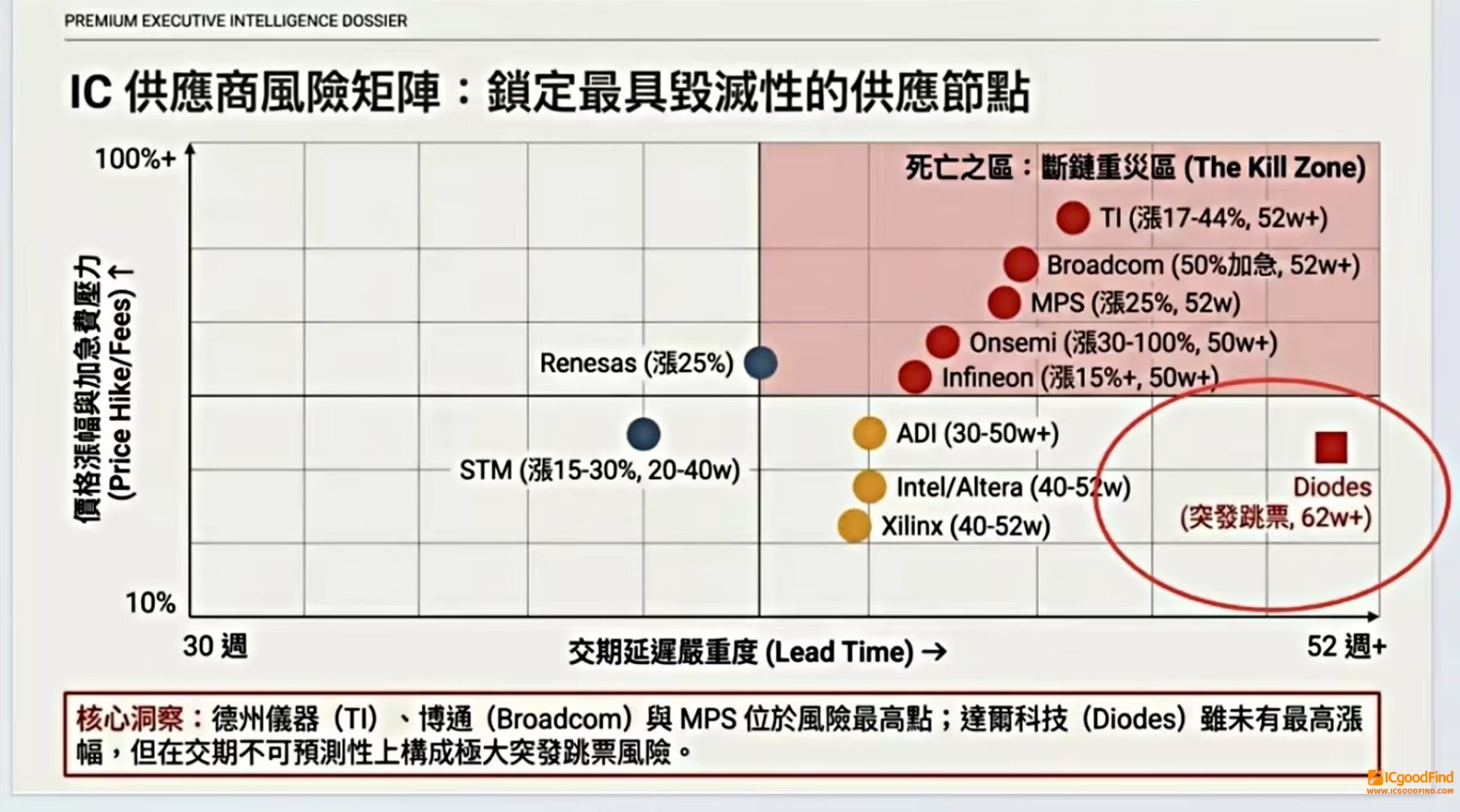
Based on the IC Supplier Risk Assessment Matrix, this article quantitatively analyzes the supply risks of mainstream manufacturers including TI, Broadcom, Infineon, STMicroelectronics and Renesas from three dimensions: delivery delay severity, price increase range, and expedited procurement cost. It also delivers actionable supply chain risk control strategies for enterprises.
Adopting a dual-axis quantitative evaluation model, the matrix eliminates subjective judgment and realizes standardized risk grading for suppliers, which is highly suitable for enterprise BOM risk control and procurement planning:
Horizontal Axis: Severity of delivery delay, measuring manufacturers’ production lead time, supply stability and delivery default probability
Vertical Axis: Supply cost pressure, covering official price hikes, spot market premiums and additional costs for expedited orders
The upper-right area of the matrix is defined as theSupply Chain High-Risk Death Zone. Manufacturers in this zone face triple risks of substantial price increases, ultra-long lead times and unstable delivery, requiring priority investigation and risk avoidance by enterprises.
Core Vendors: Texas Instruments (TI), Broadcom, MPS, ON Semiconductor, Infineon
These manufacturers represent the highest supply risk level in the current market with extremely tight overall supply conditions. In terms of pricing, their product prices have increased by 17% to 100%+, with significant premiums for core power, analog and power discrete devices. In terms of delivery, the standard lead time generally exceeds 52 weeks, which fails to match the mass production rhythm of most enterprises.
Meanwhile, the expedited sourcing cost for these components remains extremely high, with scarce spot supplies and soaring market premiums. Insufficient stocking and missing alternative solutions will easily cause project suspension, mass production interruption and order breach, making them the top priority of supply chain risk management.
Core Vendor: Renesas
Renesas is precisely on the boundary of the high-risk zone with polarized risk characteristics. It has witnessed a substantial price increase of 25%, bringing obvious cost pressure. Its lead time is close to the industry critical threshold, and the delivery cycle of some industrial and automotive-grade chips fluctuates frequently. Although it has not fallen into severe delivery delay, its supply uncertainty has risen sharply and requires continuous monitoring.
Core Vendors: ADI, Intel Altera, Xilinx
The overall risk of this vendor tier is relatively moderate, with long delivery cycles as the core pain point. Affected by capacity allocation and order backlogs, the delivery period of some high-end analog chips and FPGAs is prolonged, affecting enterprises’ early material planning. However, these vendors have minimal price fluctuations and stable procurement costs without excessive market premiums, making them suitable for regular stocking.
Core Vendor: STMicroelectronics (ST)
STMicroelectronics is the most stable mainstream international chip vendor at present. It features controllable price increases, no extreme market premiums, a healthy overall delivery cycle and high supply stability. It can serve as a core buffer for enterprise material stocking amid supply chain fluctuations.
Key Alert: Diodes Incorporated
Although Diodes does not rank top in terms of price hikes, it faces hidden but critical risks of unexpected delivery delays and defaults. Currently, the lead time of its core components exceeds 62 weeks, far higher than the industry average, with unpredictable delivery schedules and frequent production schedule adjustments.
This type of risk is easily overlooked by enterprises. Temporary small-batch procurement often leads to sudden delivery delays and supply interruptions, disrupting R&D and mass production plans, making it a typical hidden high-risk vendor.
Combined with the risk grading of various vendors, we have sorted out standardized and implementable coping strategies for R&D, procurement and production teams targeting different risk-level materials.
Inventory Strategy: Abandon temporary short-term procurement. Sign long-term price-locked and quantity-locked orders, and stock up safety inventory to cover 3-6 months of mass production demand.
R&D Strategy: Proactively verify domestic substitutes and parametric alternative components, and file backup BOM solutions to avoid project stagnation caused by single-component dependency.
Channel Strategy: Build multi-supplier channels and avoid reliance on a single authorized agent to prevent channel supply interruptions.
Avoid temporary small-batch emergency procurement, which is highly likely to result in indefinite delivery delays.
Prioritize signing delivery-guaranteed framework cooperation agreements to lock production scheduling priority.
Sort out alternative components continuously to reduce the reliance of core products on Diodes devices.
Treat these materials as the main buffer for BOM stocking with regular normalized inventory to balance overall supply chain risks.
Regularly monitor lead time and price fluctuations, establish monthly risk ledgers, and predict market trends in advance.
Optimize BOM structure via reasonable matching of high and low-risk materials to disperse dependency on single vendors.
The IC industry has bid farewell to the era of stable and sufficient supply. Supply chain security is as important as cost control. For hardware enterprises, the era of simply cutting procurement costs is over. Proactive risk identification, graded risk management and sufficient alternative solutions are the core guarantees for stable project mass production.
Through quantitative grading via the risk matrix, enterprises can accurately distinguish high-risk, medium-risk and stable materials, and formulate targeted strategies for inventory, substitution and channel management. This effectively avoids production stagnation and order losses caused by price hikes, supply shortages and delivery defaults, greatly improving the anti-risk capability of enterprise supply chains.
ICGOODFIND Supply Chain Support As a professional one-stop original electronic component procurement platform, ICGOODFIND has long been deeply engaged in the semiconductor supply chain. For high-risk materials from TI, Broadcom, Diodes and other vendors with unstable delivery cycles and frequent price fluctuations, we maintain sufficient spot inventory and strictly verify original factory sources to eliminate fake and shoddy materials and invalid spot resources. Meanwhile, we have built a rich alternative component database, providing one-stop services including material inquiry, real-time price checking, spot locking and domestic substitution scheme selection. We help hardware and manufacturing enterprises effectively avoid delivery jump risks, out-of-stock crises and continuous price increases, and build a solid safety barrier for project R&D and mass production.
